Does Your Google Business Profile Need A Website?
Understand what a Google Business Profile can handle, what still belongs on a business-owned website and when a profile-first approach is reasonable.
 Ben DunleaFounder, Hatch
An eligible Irish business can create a Google Business Profile without a website. But the profile is not a complete replacement. It is a Google-controlled discovery and action surface; a website is the business’s deeper, more controllable source for services, proof, qualification, policies, content and measurement.
What the profile can do well
A verified profile can show the business across Google Search and Maps with applicable:
- name, category and description;
- address or service area;
- regular and special hours;
- phone and website;
- services, products and attributes;
- photos, updates and reviews;
- calls, directions, messages or bookings; and
- performance indicators.
That makes it particularly useful when a customer needs an immediate action: call a plumber, check opening hours or navigate to a shop.
Google’s performance documentation includes applicable calls, directions and website clicks alongside searches/views. These remain platform interactions; connect them to qualified leads and sales before judging value.
What a website adds
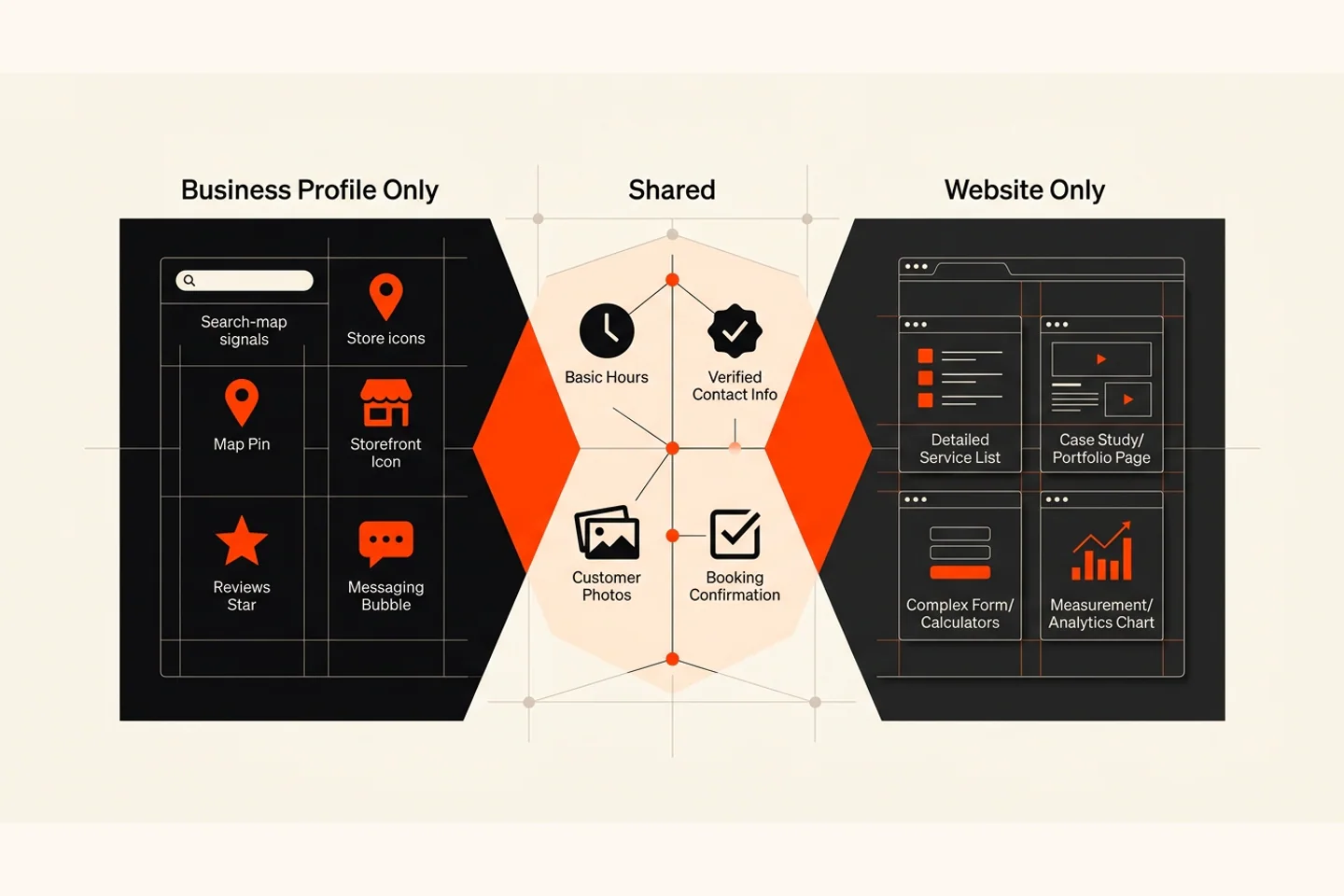
| Customer need | Profile | Website |
|---|---|---|
| Quick hours, call or directions | Strong | Can support |
| Detailed service scope/exclusions | Limited | Strong |
| Comparisons, process and price factors | Limited | Strong |
| Case studies and organised proof | Partial | Strong |
| Full accessibility/conversion control | Platform-controlled | Business/specification-controlled |
| Policies and complex information | Limited | Appropriate home |
| Landing pages for email, ads, partners and AI citations | Limited | Strong |
| First-party analytics and experimentation | Platform metrics | Deeper journey measurement |
| Portability across discovery channels | Google-specific | Broadly linkable business asset |
Why profile-only dependence is risky
The business controls profile inputs but operates inside Google’s eligibility, moderation, feature and display systems. Edits can be reviewed, features vary, user contributions can affect information and access disputes or suspensions can interrupt visibility.
A website also depends on a domain, host and technology providers, so “owned” is not absolute. The difference is practical control and portability: the business can choose hosting, information architecture, page depth, forms, measurement and destinations shared across search, email, directories, partners and advertising.
Keep primary profile ownership and the domain in business-controlled accounts. Do not allow an agency to be the sole owner of either.
Does a website help local visibility?
Google says local results mainly use relevance, distance and prominence. Its local ranking guidance notes that ordinary web position contributes to local prominence.
A strong website can:
- explain services more completely than profile fields;
- demonstrate real geographic delivery and local proof;
- earn relevant links and mentions;
- give reviews and case evidence meaningful context;
- provide crawlable pages connected through internal links; and
- convert customers who need more assurance.
It cannot move the business closer to every searcher or guarantee Map Pack placement. Avoid publishing thin town pages simply to simulate coverage.
Link the profile to the right destination
For a single-location business, the homepage may be the strongest complete destination. A real multi-location company may link each profile to a substantial corresponding location page. A service-area business can link to a core service/area page that honestly explains coverage without exposing a hidden home address.
Eligible booking, ordering and other business links should go directly to a working relevant action. Google’s business-link policy requires valid, crawlable destinations and notes feature availability varies.
Use consistent UTM parameters where appropriate, test redirects and ensure the landing page continues the promise made on the profile.
When profile-first can be reasonable
A short profile-first phase may suit a newly established, simple local operator that:
- is clearly eligible and verified;
- offers a narrow service with a straightforward phone-based sale;
- has limited startup budget;
- maintains accurate hours, services and contact information; and
- has a defined date to reassess website needs.
It is less suitable when customers compare complex scopes, need policies/credentials, buy online, research over weeks, require detailed accessibility, or arrive through multiple channels.
Social pages are not a full substitute either. They add another platform dependency and often make structured service information difficult to navigate.
Build a minimum viable local website
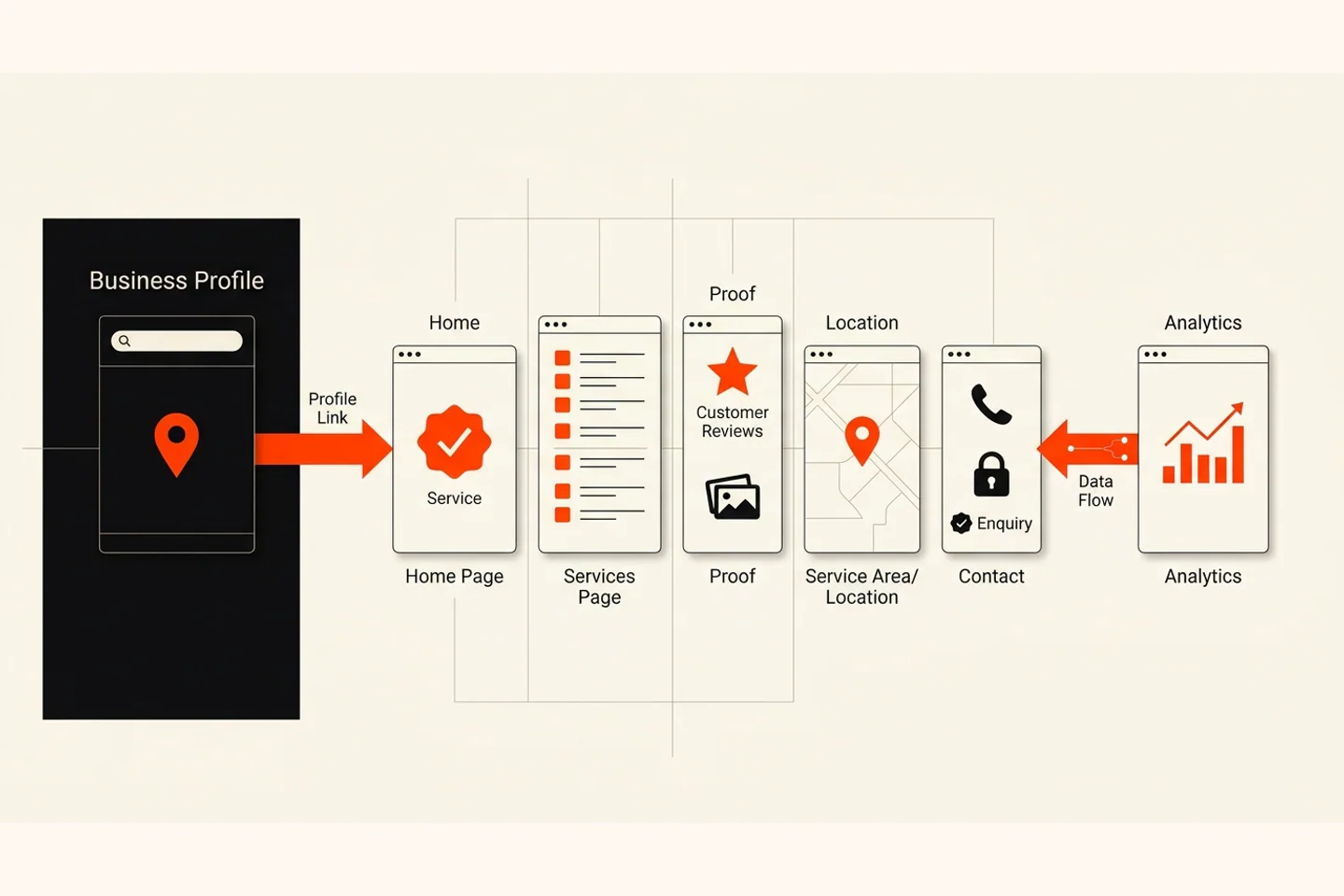
A useful first website can be compact:
- Home: clear offer, audience, location reality, proof and action.
- Services: substantial sections or separate pages for materially different services.
- About/proof: team, qualifications, process and approved customer evidence.
- Area/location: real delivery information where it adds value.
- Contact and policies: monitored channels, expectations and accurate privacy/legal information.
If one page can hold this clearly, start with one page and anchor navigation. Add separate URLs as services, evidence and customer intents become distinct—not merely to make the site look larger.
Make both assets agree
Maintain one business-facts sheet for name, category, address visibility, service areas, phone, hours, services and official URLs. Review the profile and website together after changes.
Use authentic photos and a compliant review process. Put relevant proof on service pages rather than copying every review into one wall. Track the journey from profile action or tagged website visit to qualified enquiry.
The Google Business Profile guide covers setup and governance; the Local SEO Ireland guide connects profiles, websites, reviews and authority.
What to do next
If the business has only a profile, list the five questions customers still ask before buying. Those unanswered questions define the first website—not a generic template page count.
Hatch’s Local SEO service can assess the profile and local evidence, while web design covers the business-owned journey. Request a local visibility review to decide whether the immediate constraint is profile accuracy, website depth or both.
Common questions
Frequently Asked Questions
Can I create a Google Business Profile without a website?
Yes, an eligible business can generally create or claim a profile without having a website. It still must meet Google's real-world eligibility and verification rules. Adding a website later can provide deeper service information, proof and conversion control.
Is a Google Business Profile better than a website?
They perform different jobs. The profile is strong for discovery, reviews, calls, directions and basic facts within Google. A website provides business-controlled depth, qualification, policies, content, analytics and destinations used across many channels.
Will adding a website improve Google Business Profile rankings?
A useful website can strengthen relevance, customer experience and wider web visibility, and Google says normal web position contributes to local prominence. It does not guarantee a particular local ranking or overcome distance.
Where should the profile website link point?
Point it to the strongest accurate page for that business or location, often the homepage for one-location businesses or a substantial location page for genuine multi-location operations. Booking or order links should go directly to a working relevant action page.
What is the minimum website a local business needs?
At minimum, clearly explain the business, core services, real location or service area, proof, price or quote factors, contact route and applicable privacy/legal information. A focused one-page site can start there if sections are substantial and usable.
Want Us To Look At Your Version?
Show us what is not working and we’ll give you a straight answer.
Founder of Hatch. Writing practical, jargon-free advice for businesses that want to get found and turn attention into enquiries.