What Pages Does An Irish Small-Business Website Actually Need?
Plan a useful small-business sitemap with the essential pages, optional page types and a test for deciding when separate service or location pages are justified.
 Ben DunleaFounder, Hatch
Most Irish small-business websites need a clear homepage, one or more service pages, an about/proof page and a contact page, plus the policies required by how the business collects data or sells. Add location, sector, pricing, case-study and FAQ pages only when each supports a genuinely different customer decision.
Start with customer decisions, not a page count
A five-page website can be excellent for one narrow business and inadequate for another. Begin by listing the questions a suitable customer must resolve:
- Am I in the right place?
- Does this business solve my specific problem?
- Does it serve my location or situation?
- Why should I trust it?
- What will happen, cost or be required?
- What is the next step?
Group questions that belong to the same intent. Split them only when the audience, service, evidence or action differs materially.
Google’s SEO Starter Guide recommends logical organisation, descriptive URLs and crawlable links. That is good customer architecture too: people should understand where they are and find related information without returning to search.
The core pages
Homepage
The homepage should establish the business, primary customer, main outcome, service range, geographic reality, proof and next step. It is a routing page, not a compressed version of every page.
Include enough substance for branded visitors to verify the company, then link to definitive service and proof pages. Avoid a hero made entirely of adjectives and a vague “learn more” button.
Service pages
Create one page per materially different service. Each should explain:
- who it is for and what problem it handles;
- scope, exclusions and prerequisites;
- process and realistic timing;
- price or price factors;
- relevant proof and FAQs; and
- the appropriate next action.
If two services use the same buyer, evidence, process and action, one stronger page may be clearer. If a buyer searches, evaluates and buys them separately, split them.
About and proof
An about page should answer why this team is qualified to do the work: people, history, methods, credentials and operating values supported by evidence. Avoid a generic origin story with no customer relevance.
Case studies and reviews should also appear beside relevant services. The about page is the verification hub, not a proof silo.
Contact
Give customers the channels the business actually monitors, expected response timing, hours, relevant address/service-area information and a form that asks only for useful information. Confirm form delivery and provide an alternative if it fails.
Privacy, cookies and applicable terms
Policies depend on actual data collection, tracking, sales and contract model. Do not paste a universal template. Map forms, analytics, advertising, embedded services, payment tools and retention practices, then obtain appropriate legal review.
Irish consumer-facing online sales can require clear identity/contact, price, delivery and cancellation information. The CCPC’s online buying guidance is a useful starting point, not a substitute for advice on the specific business.
When optional pages are justified
Separate location pages
Create one when the business has a genuine location or meaningfully different evidence and delivery details for the area. Useful material might include local projects, travel/availability, team, service constraints, customer proof and specific questions.
Do not clone a page for every town and replace only the place name. Google’s spam policies describe doorway abuse as pages created to rank for similar queries that funnel users to the same destination.
Industry or customer-type pages
Add a sector page when regulations, workflow, terminology, proof or service configuration differs. “Web design for dentists” needs more than changing “small business” to “dentist”.
Pricing
Buyers need commercial orientation even when every quote is bespoke. Use fixed prices, packages, starting points, planning ranges or a transparent list of scope variables. Link the numbers to inclusions, exclusions and VAT treatment.
Case studies
Create a separate case when approved evidence supports a real decision: baseline, problem, choices, delivery and measured outcome with period/source. Never manufacture a client, quotation or metric.
Team pages
Individual profiles help when expertise, trust or practitioner choice matters. Include real role, relevant credentials and authored content; avoid empty biographies created only for schema.
FAQs and resources
Place questions where they unblock a decision. A central FAQ can cover company-wide matters; guides and tools deserve separate URLs when they solve substantial tasks and can stand alone.
Use the separate-page test
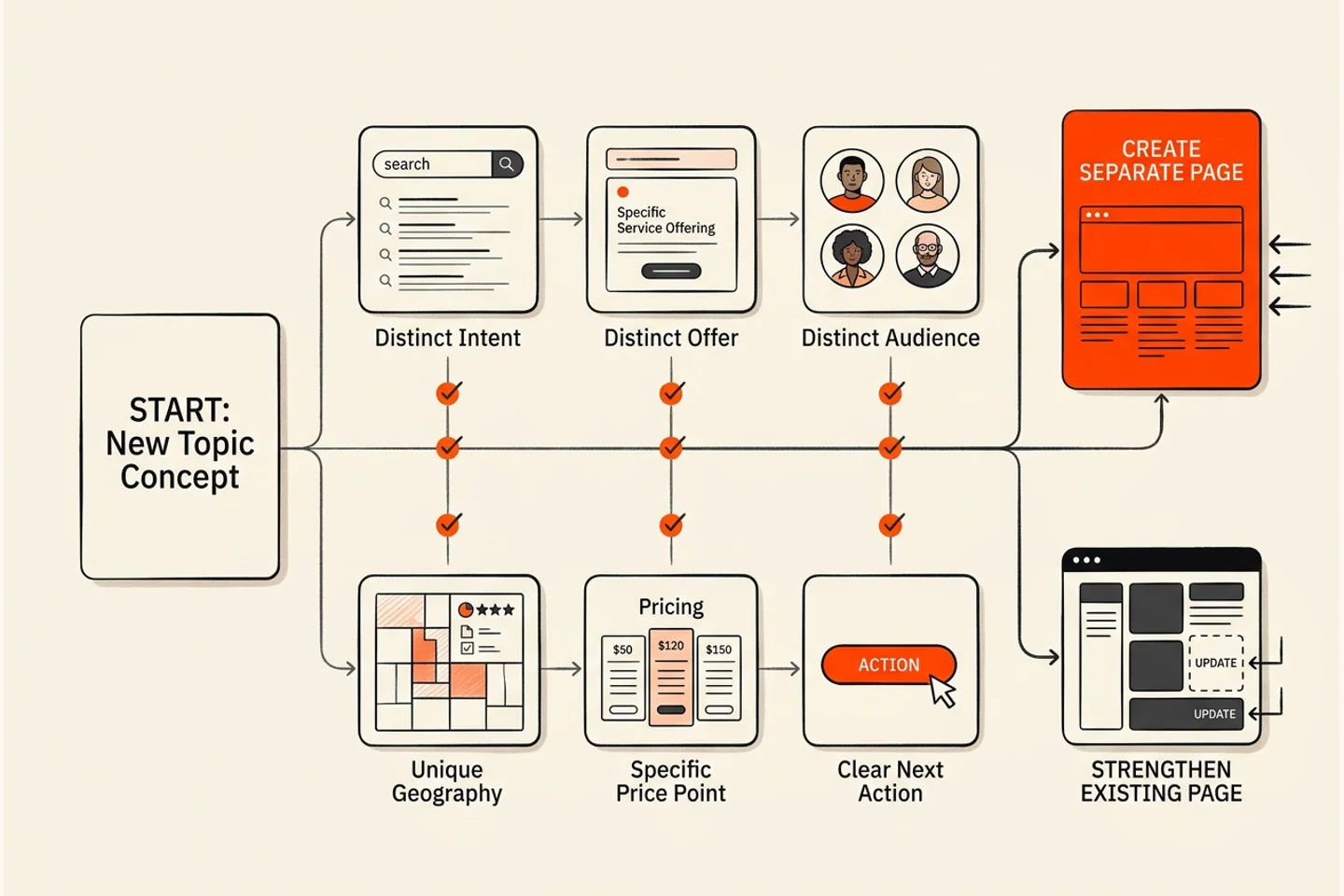
Give a topic its own page when at least two of these change materially:
- customer/search intent;
- offer and scope;
- audience or eligibility;
- process or price factors;
- evidence required;
- geographic delivery; or
- next action.
If none changes, strengthen the existing page and add a clear section with a linkable heading.
Three example sitemaps
Local service business
Home → individual core services → about/proof → justified service-area/location page → contact → policies.
Professional firm
Home → practice/service areas → sector pages where advice differs → people → insights/cases → contact → policies/terms.
Ecommerce business
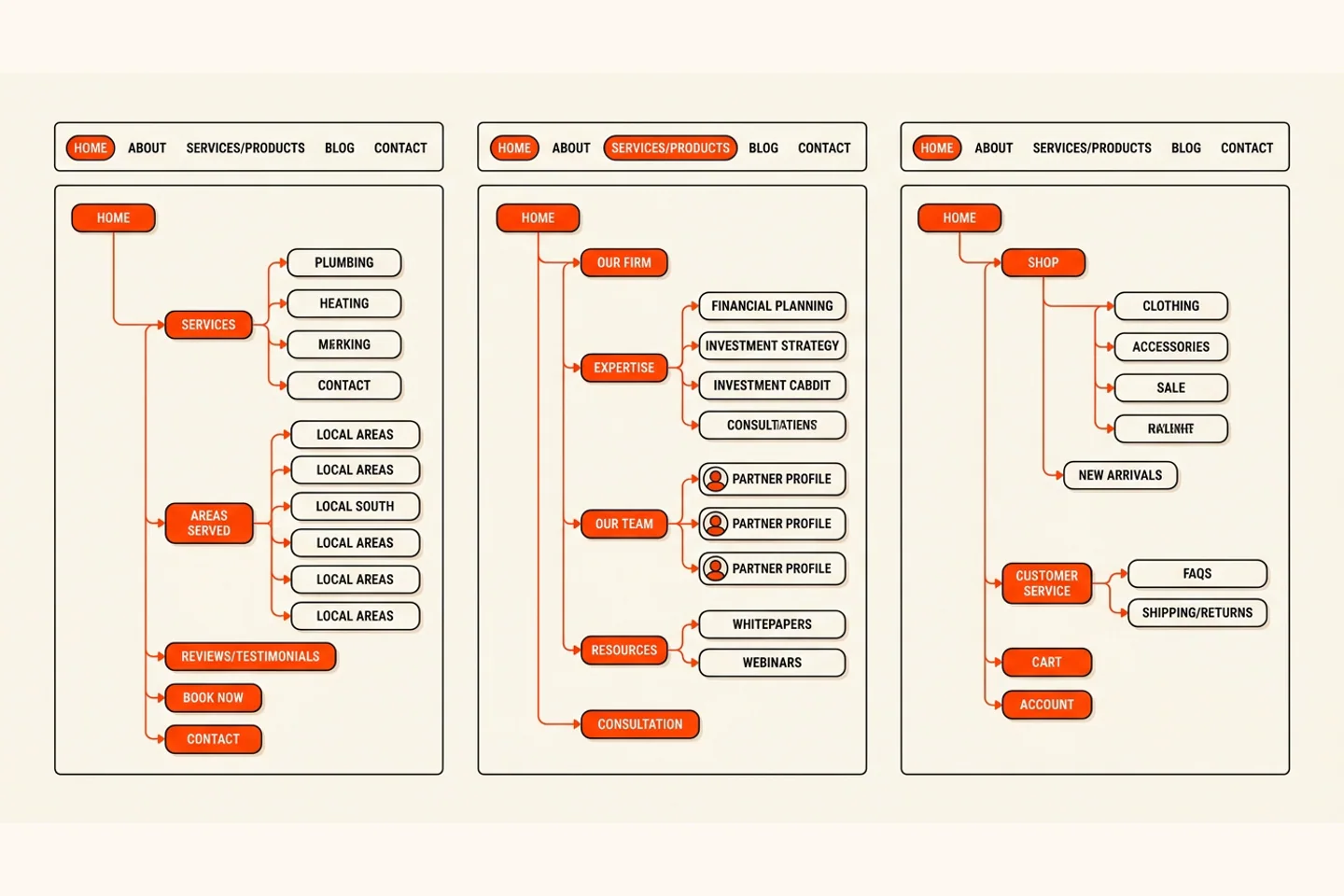
Home → categories → products → delivery/returns → about/proof → support/contact → basket/checkout → policies and terms.
What to do next
Write every proposed page on a card with its reader, question, evidence and action. Merge cards that duplicate one another. Flag any priority service with no destination and any location page with no local substance.
Use the Irish Small-Business Website Playbook for content, proof, accessibility and measurement. The website cost guide explains how page types affect scope. Hatch’s web design service can turn the final architecture into a practical brief; contact Hatch to review it.
Common questions
Frequently Asked Questions
How many pages should a small-business website have?
There is no correct universal number. A simple service business may begin with five to eight substantial pages, while multiple services, locations, sectors or ecommerce journeys justify more. Every page should support a distinct customer decision or operational requirement.
Does every service need its own page?
Give a service its own page when it has a distinct customer need, scope, evidence, process, price factors or next action. Closely related minor services may be clearer together on one strong page.
Should every town served have a location page?
No. Create a town or county page only when it contains genuine local proof, delivery details or useful location-specific answers. Near-duplicate pages that merely swap place names can confuse customers and resemble doorway pages.
Does a small business need a pricing page?
Not always, but buyers need enough cost information to understand fit. Publish fixed prices, starting prices, packages, typical ranges or a clear explanation of the factors that determine a quote.
Should FAQs have a separate page?
Put important FAQs near the service or decision they support. A central FAQ page can help with broad company questions, but it should not remove useful answers from relevant service and contact pages.
Want Us To Look At Your Version?
Show us what is not working and we’ll give you a straight answer.
Founder of Hatch. Writing practical, jargon-free advice for businesses that want to get found and turn attention into enquiries.