Should You Create A Separate Page For Every Town You Serve?
Decide when Irish town and county pages add genuine local value, when one service-area page is better and how to avoid doorway-page duplication.
 Ben DunleaFounder, Hatch
Do not create a separate page for every town simply because the business can travel there. Build a location page when the place changes the customer’s question, service delivery, available proof or next action. If twenty pages would say substantially the same thing, one strong service-area page is usually more honest and useful.
Why businesses create too many location pages
The logic appears reasonable: if customers search for a service in Cork, Limerick and twenty surrounding towns, publish a page for each phrase. The result is often a template with one swapped heading, the same testimonials, identical process and a form leading to the same team.
Google’s spam policies describe doorway abuse as pages created for similar queries that funnel users to one destination, including substantially similar pages targeted at regions or cities. Not every location page is a doorway. The risk is the purpose and lack of distinct usefulness.
Use the six-factor test
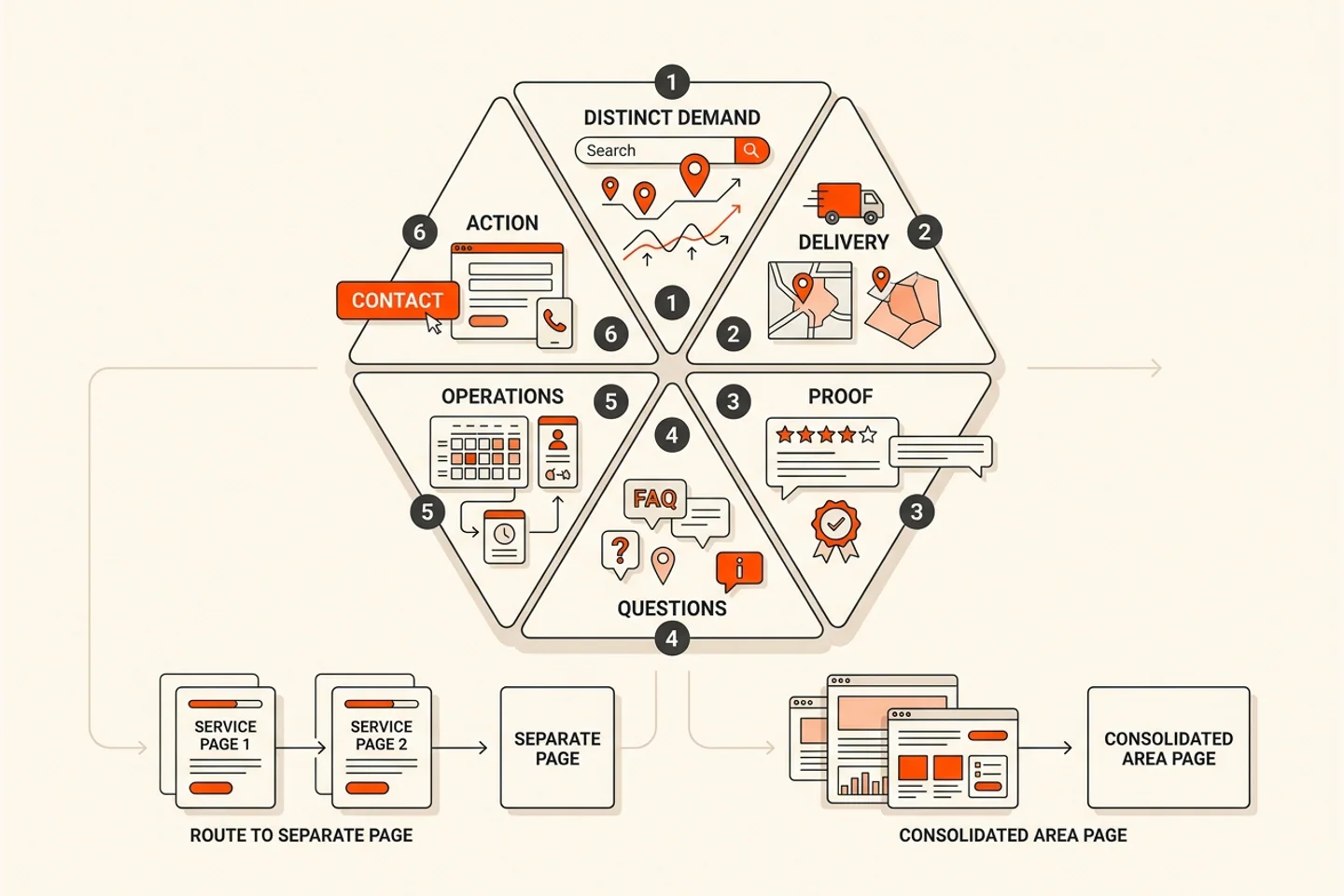
Score one point for each honest “yes”:
- Demand: Do customers in this place express a distinct, meaningful need?
- Delivery: Do availability, travel, response or scope differ here?
- Proof: Is there approved local work, feedback, team or partnership evidence?
- Questions: Are there genuinely location-specific considerations?
- Operations: Is there a real staffed branch or materially different service model?
- Action: Should the visitor contact a different team, book differently or provide different information?
A score of 0–1 normally favours the main service/service-area page. At 2–3, a separate page may work if the material is substantial. At 4–6, a distinct page is easier to justify. This is a Hatch planning aid, not a Google formula.
Distinguish physical locations from service areas
A staffed branch customers can visit may justify its own profile and page with address, hours, team, directions and local proof. A service-area business travelling from one base should not imply it has offices in every town.
Google’s service-area guidance explains that areas communicate where the business travels or delivers. They do not create branches or remove distance from local results.
For a non-physical town page:
- say the business serves the area rather than “is located in” it;
- do not add a fake address, embedded pin or fabricated local phone;
- do not use
LocalBusinessmarkup for a location that does not exist; and - explain actual coverage, constraints and response expectations.
What makes a useful local page?
A valuable page may contain:
- services genuinely available in that area;
- relevant travel, delivery, lead-time or call-out details;
- approved projects or case evidence from the place;
- customer feedback with permission and accurate context;
- local regulations, property types or conditions that materially affect work;
- team/branch information when real; and
- a next step tailored to the service model.
Do not add generic landmarks, population facts or rewritten tourism copy merely to appear local. The test is whether a resident makes a better decision after reading it.
Choose the right architecture
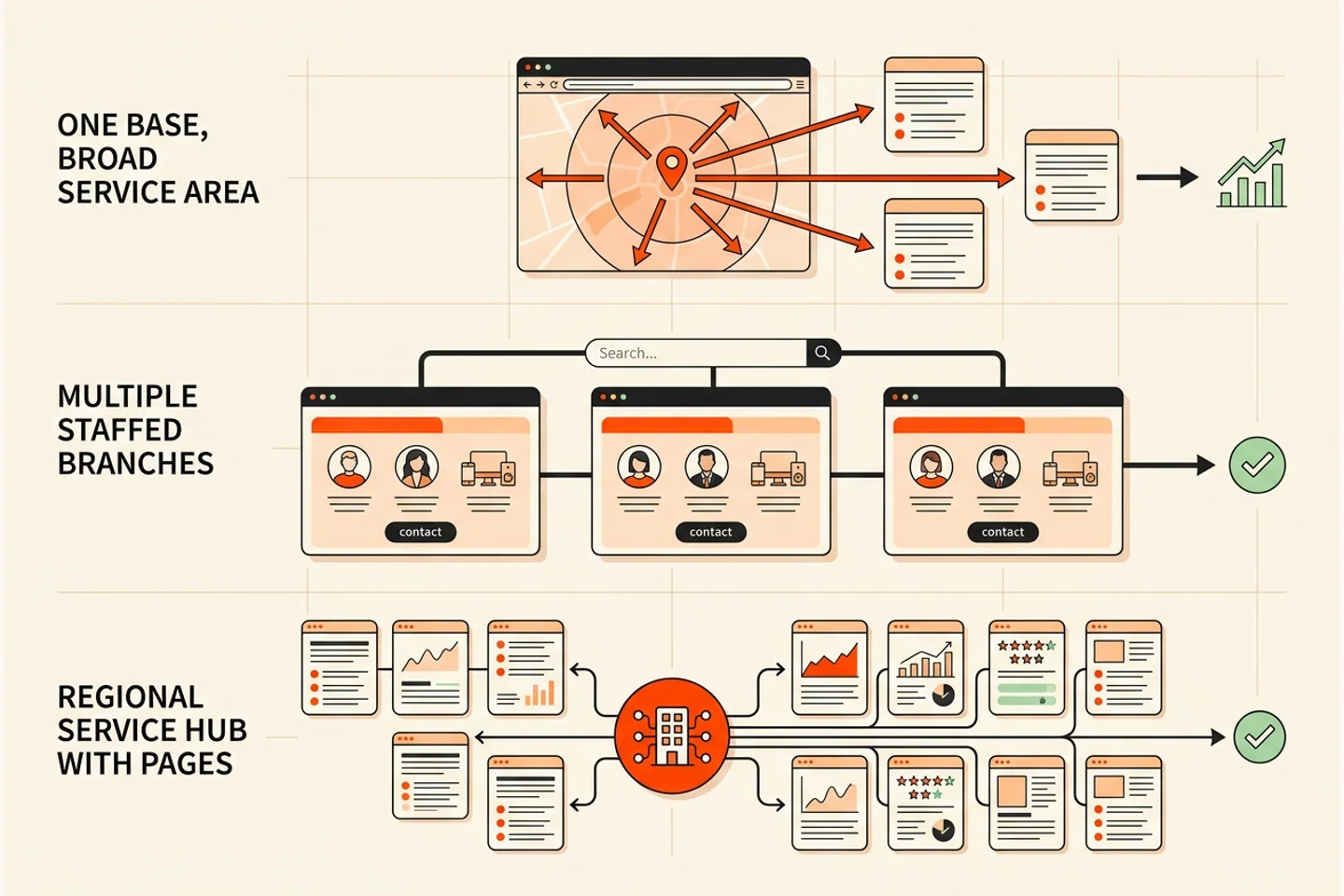
| Business reality | Sensible structure |
|---|---|
| One base, broad similar coverage, little town-specific proof | Core service pages plus one clear service-area section/page |
| One base, selected towns with distinct demand and evidence | Core service pages plus a small number of evidence-rich town pages |
| Several genuine staffed branches | One substantial location page per branch, connected to relevant services |
| Regional differences in service/process | Regional hubs with distinct operational detail and selected child pages |
Improve or consolidate existing pages
Inventory every location URL with traffic, queries, links, conversions, content and local evidence. Then:
- Keep/improve a page with a distinct useful role.
- Merge overlapping pages into the closest comprehensive destination and use a direct permanent redirect.
- Remove a page with no useful replacement using a genuine
404/410and update links/sitemap.
Do not redirect every town page to the homepage. Preserve genuinely useful local material in the destination and monitor Search Console, organic landing pages and qualified leads after consolidation.
What to do next
Choose the five towns most important commercially and run the six-factor test. If evidence is missing, collect real proof before creating pages. If customer needs are identical, strengthen the main service-area explanation instead.
Read the Local SEO Ireland guide and Google Business Profile guide before changing location architecture. Hatch’s Local SEO service can audit existing pages; request a location architecture review for a keep, improve, merge or remove map.
Common questions
Frequently Asked Questions
Does every town served need its own website page?
No. Create a town or county page only when local demand, delivery, evidence or customer questions make it a genuinely distinct destination. Otherwise use one strong service or service-area page.
Do location pages help local SEO?
Useful location pages can help customers and search engines understand genuine local delivery. Near-duplicate pages that only change place names add little value and may resemble Google's doorway-abuse examples.
Can a service-area business create town pages without an office there?
Yes, if it genuinely serves the town and the page clearly describes that service without implying a non-existent branch. Do not publish an address, map or LocalBusiness markup that suggests a physical location where none exists.
How much local content should a location page contain?
There is no minimum word count. Include enough original evidence and practical detail to answer the local customer's decision. If the page cannot be useful without padding or invented claims, it probably should not exist separately.
What should happen to thin existing location pages?
Improve those with genuine value, consolidate overlapping pages into the strongest relevant destination with direct permanent redirects, or remove pages that have no replacement while updating internal links and sitemaps.
Want Us To Look At Your Version?
Show us what is not working and we’ll give you a straight answer.
Founder of Hatch. Writing practical, jargon-free advice for businesses that want to get found and turn attention into enquiries.