WordPress, Webflow, Shopify Or A Custom Build For An Irish SME?
Compare website platforms by editing, commerce, integrations, ownership, maintenance, performance and total operating fit—not popularity alone.
 Ben DunleaFounder, Hatch
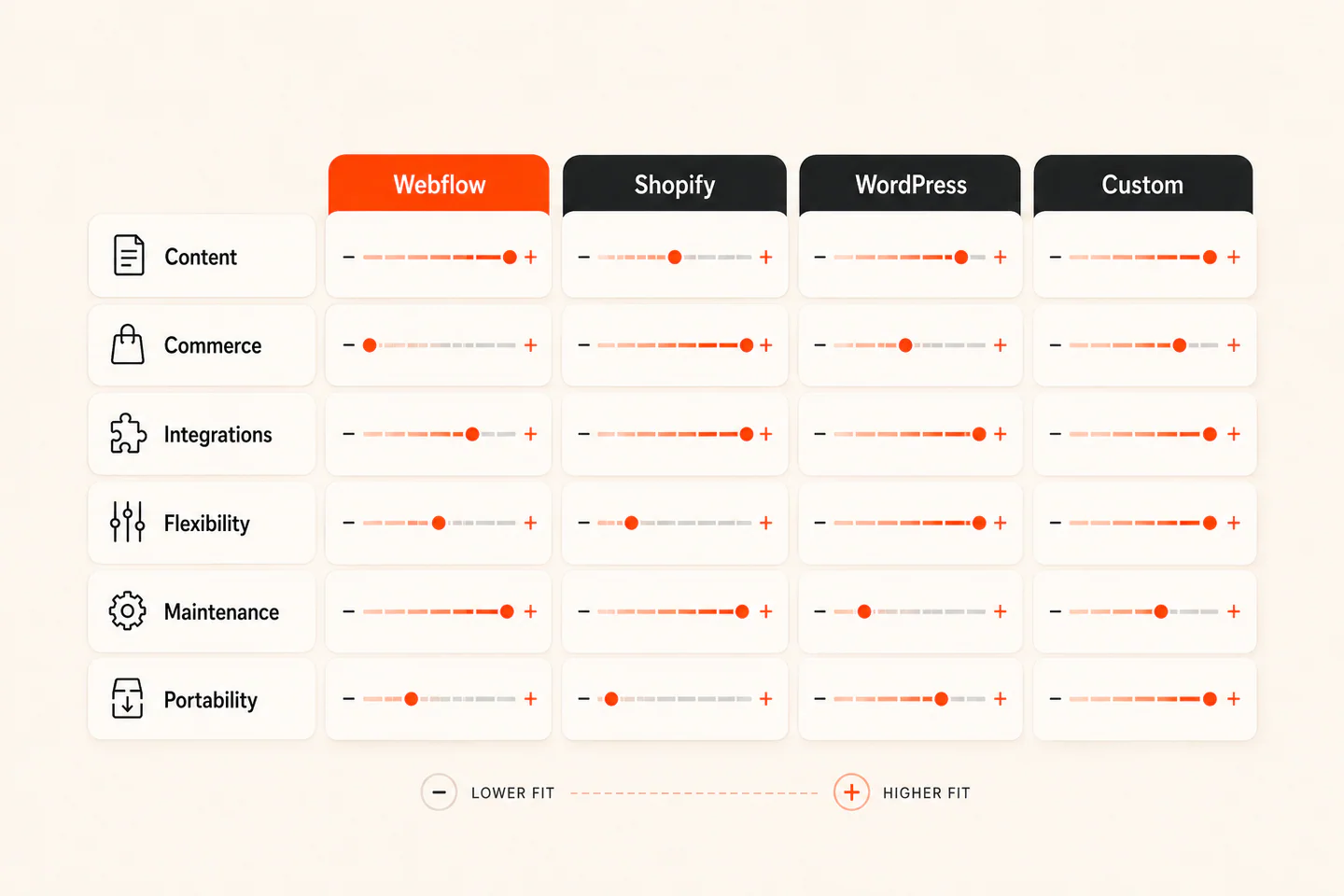
Choose the least complex platform that safely supports the business’s real editing, selling, integration and governance needs. WordPress is flexible and open-source; Webflow is a hosted visual CMS; Shopify is commerce-first; custom development is for requirements that create enough value to justify continuing engineering ownership.
Compare operating models
| Option | Often strongest fit | Main responsibility/risk |
|---|---|---|
| WordPress | Content-rich marketing sites needing broad extensibility and supplier choice | Hosting, updates, plugin/theme quality and maintenance must be governed |
| Webflow | Design-led marketing sites with structured content and a hosted visual workflow | Platform limits, plan dependency and incomplete functional portability |
| Shopify | Product, inventory, checkout and multichannel commerce | Recurring plan, payment, app/theme and transaction ecosystem costs |
| Custom | Distinctive workflows, products or integrations that create strategic advantage | Engineering continuity, documentation, security, hosting and key-person risk |
Any option can be implemented badly. “Built in X” does not prove accessibility, speed, security, editability or SEO quality.
When WordPress fits
WordPress.org describes an open-source, GPL-licensed system with themes, plugins, custom content types and a REST API. It can serve a small brochure site or a complex publishing platform.
Choose it when the business values:
- broad developer and agency availability;
- flexible content types and integrations;
- control over hosting and code choices;
- established publishing workflows; and
- portability beyond one hosted vendor.
The trade-off is operational. Someone must own hosting, core/theme/plugin updates, backups, restoration, security monitoring, licences and compatibility testing. A large plugin list is not capability without governance.
Do not confuse WordPress software with a particular managed host or page builder. Quote them as one operating system: exactly who updates what, how often, in which test environment and what happens after a failed release.
When Webflow fits
Webflow can suit a design-led marketing site where visual development, reusable components and structured CMS content are managed within a hosted platform. It reduces some infrastructure decisions while keeping design control relatively close to the builder.
Choose it when:
- the primary product is a marketing/content website;
- the proposed content model fits platform limits;
- trained editors are comfortable with the workflow;
- hosting within the platform is acceptable; and
- advanced application/commerce needs are modest or handled elsewhere.
Portability needs precise language. Webflow’s official export documentation says code export is available on qualifying paid Workspace plans, but CMS-bound pages/content functionality, ecommerce, users, forms, search and localisation do not export as a complete working system. Content can have separate CSV exports, but rebuilding functionality still carries cost.
When Shopify fits
Shopify is usually the most direct option here when the website is fundamentally a retail operation: catalogue, inventory, checkout, payment, shipping, discounts, returns, markets or point of sale.
Its Irish pricing page describes included commerce hosting, SSL, product selling, checkout, payment/transaction considerations, apps and plan-dependent features. Prices and country availability change, so verify the live plan and model total costs before signing.
Choose Shopify when the benefit of a mature commerce operating system outweighs platform and app dependency. Include:
- subscription and payment/transaction fees;
- premium theme and app licences;
- development and support;
- product/catalogue operations;
- integrations and data exports;
- international/POS requirements; and
- checkout customisation limits by plan.
A service business with no meaningful online transaction may pay for complexity it does not use.
When custom development is justified
Custom is appropriate when the website is also a differentiated software product or must support a verified workflow unavailable in standard platforms—for example, unusual quoting logic, customer portals, proprietary data, multi-system orchestration or performance/security constraints.
Require a written case:
- What requirement cannot a supported platform meet?
- What commercial value does custom create?
- Who will maintain code, dependencies, infrastructure and security?
- What testing, documentation and observability are included?
- How can another competent team take over?
If the need is ordinary pages, forms and a CMS, custom often adds risk without customer value. Hatch should recommend against it when a standard solution fits.
Score the requirements before seeing proposals
Weight each criterion from 1–5, then score the credible implementation—not the platform in theory.
| Criterion | Questions to answer |
|---|---|
| Editing | Who publishes which content, with what approvals and frequency? |
| Commerce | Products, payments, stock, shipping, returns, POS and markets? |
| Integrations | Which systems exchange what data, how often and with what failure handling? |
| Ownership | Who controls domain, accounts, data, licences, repository and billing? |
| Maintenance | Who patches, tests, backs up, restores and supports? |
| Performance/accessibility | What acceptance tests apply to real templates and journeys? |
| Exit | What can be exported, in which format, and what must be rebuilt? |
| Five-year cost | Build, subscriptions, fees, apps, support, change and migration? |
Do not let one heavily marketed feature outweigh critical workflows.
Run the exit test

Before choosing, ask what happens if the supplier or platform relationship ends:
- Can the business control the domain and DNS?
- Can it export pages, media, products, customers and submissions in useful formats?
- Which design assets and licences transfer?
- Is source code available, documented and deployable elsewhere?
- Which hosted features stop working?
- Can administrator, analytics and integration accounts be transferred?
- What legal retention/deletion steps apply?
What to do next
Write the top ten requirements and give each a weight before requesting a platform recommendation. Ask every supplier to explain one option they rejected and why. If all roads lead to the supplier’s only tool, you have learned about the supplier—not necessarily your fit.
Use the website cost guide for five-year ownership planning and agency selection guide for proposal questions. Hatch’s web design service covers marketing platforms; genuinely software-shaped requirements belong under custom software. Book a platform recommendation call when the requirements are ready.
Common questions
Frequently Asked Questions
Which website platform is best for an Irish small business?
There is no universal winner. A content-led service business may suit well-managed WordPress or Webflow; a conventional online retailer often benefits from Shopify; custom development is justified when distinctive workflows or integrations create real value that supported products cannot deliver efficiently.
Is WordPress free?
The open-source WordPress software can be used without a software licence fee, but a production site still needs hosting, domain, design/development, maintenance, security, backups and potentially paid themes, plugins or services.
Can a Webflow website be exported?
Webflow documents code export on qualifying paid Workspace plans, but hosted functionality such as CMS-bound pages, ecommerce, user accounts, forms, search and localisation does not export as a complete working system. Define the exit process before purchase.
Is Shopify only for large online shops?
No. Shopify serves small through complex retailers and includes hosted commerce infrastructure. It may be excessive for a brochure-only service site, while a retailer should compare payment, app, theme, international, POS and recurring costs against its transaction model.
Is a custom website better for SEO?
Not automatically. Search performance depends on crawlability, content, architecture, page experience and authority. Custom code can provide precise control, but poor implementation can perform worse than a well-configured standard platform.
When should an SME choose a custom build?
Choose custom when a verified workflow, integration, product or performance requirement creates enough strategic value to justify ongoing engineering ownership. Do not choose it merely to make a normal marketing website feel premium.
Want Us To Look At Your Version?
Show us what is not working and we’ll give you a straight answer.
Founder of Hatch. Writing practical, jargon-free advice for businesses that want to get found and turn attention into enquiries.