Does Schema Markup Help You Appear In ChatGPT Or AI Overviews?
Learn what structured data can clarify, why it cannot guarantee AI inclusion and which schema types suit an Irish service-business website.
 Ben DunleaFounder, Hatch
Schema markup can help machines understand explicit facts on a webpage, and it can make pages eligible for supported search features. It does not guarantee a ChatGPT citation, an AI Overview link or a higher ranking. Google explicitly says no special schema is required for its AI features.
What structured data does
Schema.org provides a shared vocabulary for entities, properties and relationships. Google describes structured data as explicit clues about page meaning and uses supported markup for eligible rich results.
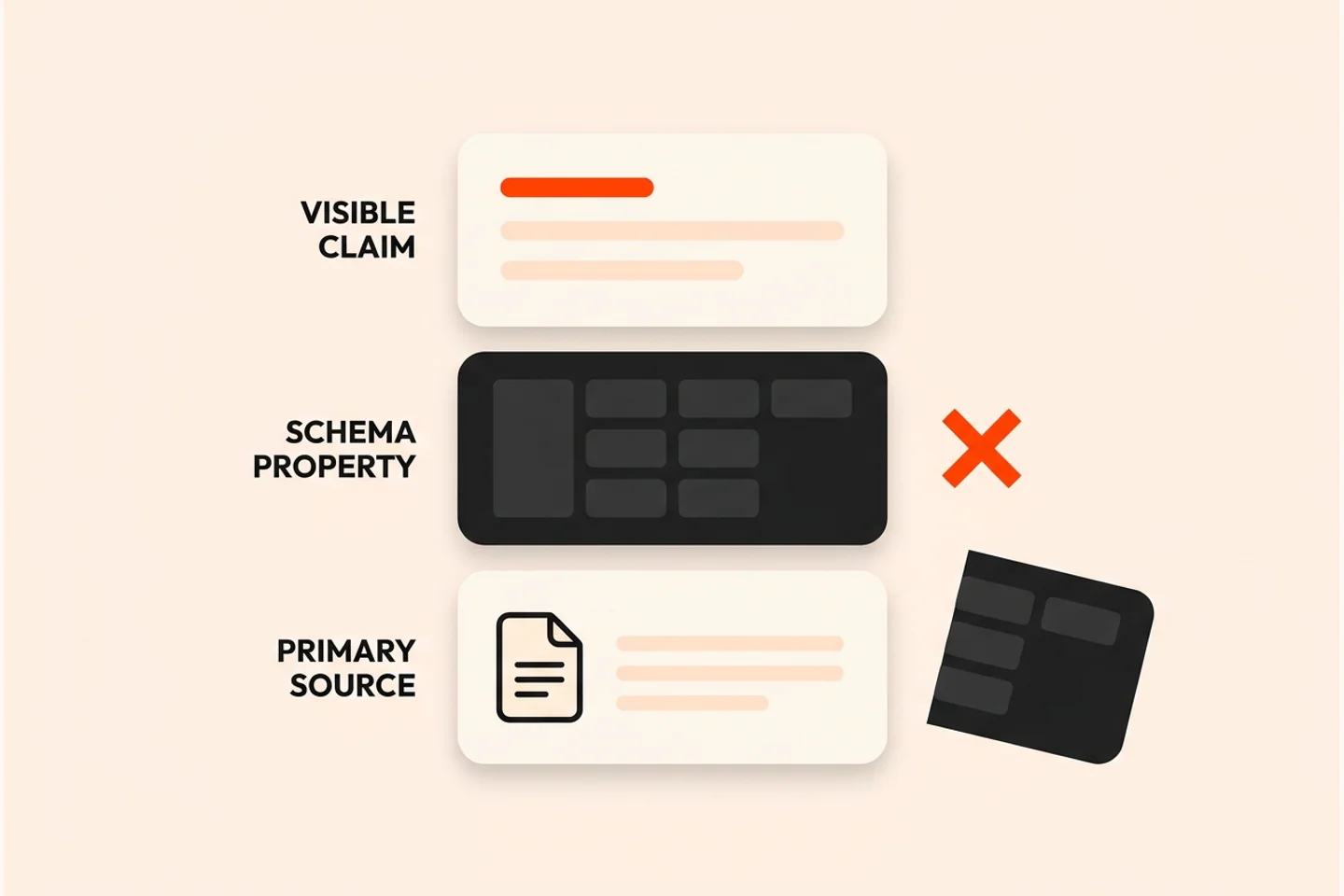
Think of three layers:
- Visible claim: “Hatch provides web design in Ireland.”
- Markup: a supported entity/service property labels that visible relationship.
- Evidence: the service page, real business details, work and independent sources support the claim.
Markup without visible content is misleading. Markup without evidence remains a labelled self-assertion.
What Google says about AI features
Google’s AI-features documentation says ordinary Search foundations remain relevant and that there is no special schema for AI Overviews or AI Mode. Structured data should match visible text.
A page must be indexed and eligible for a snippet to appear as a supporting link, but meeting requirements never guarantees crawling, indexing or selection. Google may use different models and queries, so links vary.
OpenAI does not publish a schema recipe that guarantees ChatGPT Search inclusion. Its public guidance emphasises OAI-SearchBot access and states that top placement cannot be guaranteed.
Choose types by page purpose
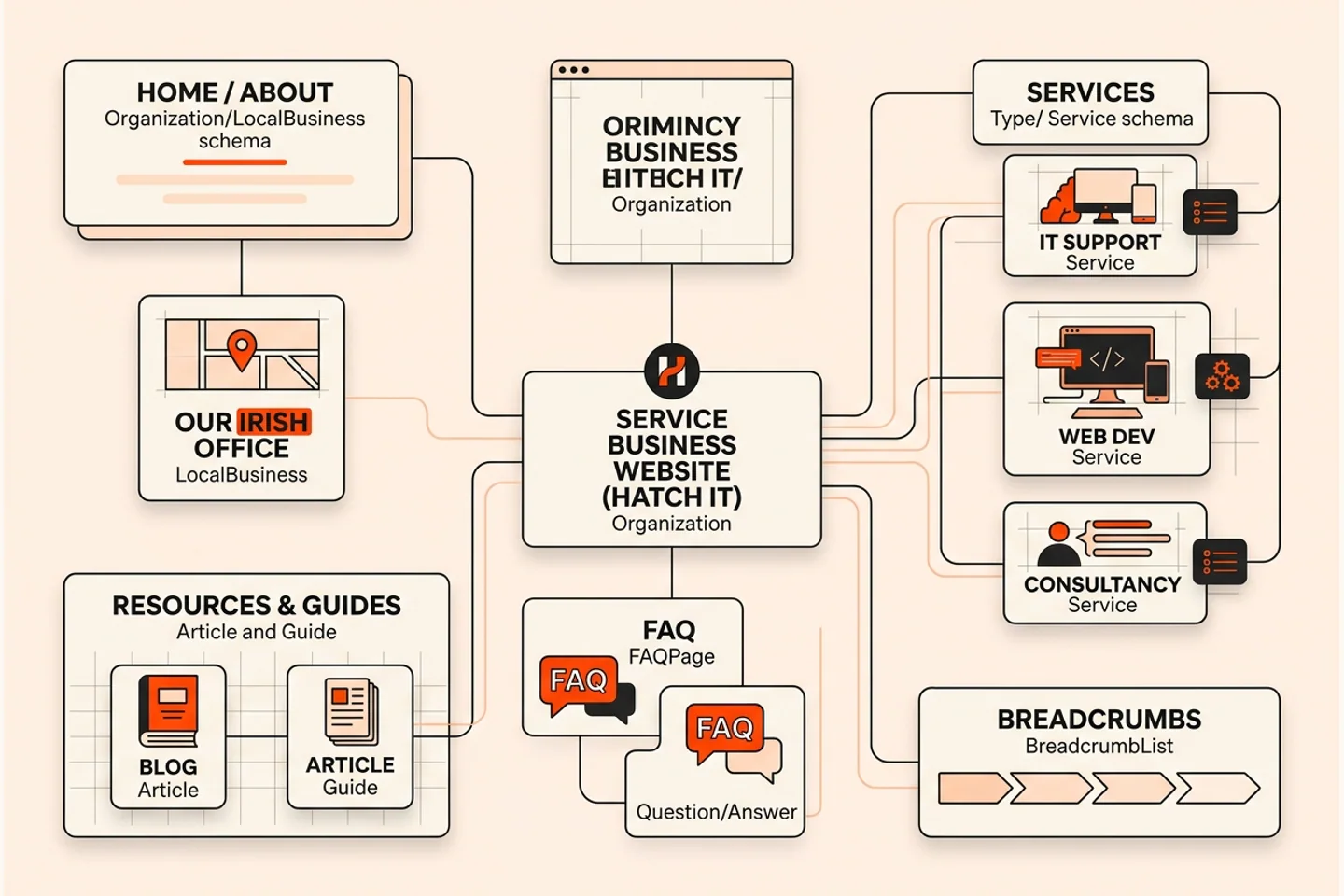
| Page/entity | Potential type | Important boundary |
|---|---|---|
| Business/home/about | Organization | Use accurate identity, URL and verified profiles |
| Genuine physical location | Specific LocalBusiness subtype | Do not create locations or public addresses that do not exist |
| Service page | Service | Describe the actual visible offer/provider/area |
| Guide or article | Article/BlogPosting | Align headline, dates and visible author |
| Navigation trail | BreadcrumbList | Match the real hierarchy |
| Visible FAQ content | FAQPage | Questions/answers must appear to users; rich-result visibility is limited |
Google’s LocalBusiness documentation says to define each real location and use the most specific subtype possible. A service-area business with no customer-facing branch should not invent addresses for town pages.
Google’s Article guidance recommends matching all visible authors and using appropriate Person or Organization types with useful URLs.
Do not chase outdated rich-result advice
Google reduced FAQ rich results mainly to well-known authoritative government and health sites and deprecated HowTo rich results. Visible FAQs can still help readers and clarify page content; adding markup solely for a promised expanded result is a weak business case.
Schema.org vocabulary is broader than features supported by Google or any AI product. A property being valid at Schema.org does not mean one consumer displays or uses it in a particular way.
Avoid common implementation errors
- Marking up information hidden from users.
- Adding fake locations, awards, reviews or ratings.
- Using
LocalBusinesson every town service page as though each were a branch. - Duplicating contradictory Organization nodes with different names/URLs.
- Leaving old hours, people or prices in generated JSON-LD.
- Assuming a plugin’s green indicator proves eligibility.
- Adding every possible property instead of fewer accurate ones.
Google’s general guidelines say a rich result is never guaranteed and potentially misleading or hidden markup can be ineligible.
Validate in three ways
- Truth check: compare every material property with visible content and the business-facts ledger.
- Vocabulary check: use Schema Markup Validator for Schema.org syntax/types.
- Feature check: use Google’s Rich Results Test and URL Inspection for Google-supported features and rendered output.
Deploy to a small set of representative pages, then monitor Search Console enhancement reports where available. Revalidate after template, CMS or business-fact changes.
What to do next
Inventory existing markup before adding more. Remove contradictions and invented defaults, then prioritise Organization/business identity, real locations, articles/authors and breadcrumbs where they match the site.
Use the AI SEO Ireland guide for the wider evidence strategy and combined local/AI guide for entity governance. Hatch’s AI Search Optimisation service can provide a structured-data and entity audit focused on accuracy rather than markup volume.
Common questions
Frequently Asked Questions
Does schema markup help with AI search?
It can make supported visible facts more explicit to systems that process it, but there is no general guarantee that ChatGPT or another AI product will use that markup or cite the page. Treat schema as clarification, not an AI-ranking lever.
Does Google require special schema for AI Overviews?
No. Google says no special schema or additional technical requirement is needed for AI Overviews or AI Mode. Pages need normal Search index and snippet eligibility, and structured data should match visible text.
Which schema types should an Irish service business use?
Commonly relevant types include Organization, a specific LocalBusiness subtype for each genuine physical location, Service, Article, BreadcrumbList and visible FAQPage where appropriate. Select types based on the actual page and Google's supported-feature documentation.
Does valid schema guarantee a rich result?
No. Google explicitly says correctly implemented structured data makes a page eligible for applicable features but does not guarantee they will appear.
Should a business add review stars to its own LocalBusiness schema?
Be cautious. Google says LocalBusiness aggregateRating/review properties are recommended for sites capturing reviews about other local businesses, and self-serving review snippets have specific restrictions. Do not mark up invented, selectively altered or ineligible ratings.
Is JSON-LD better than microdata?
Google supports JSON-LD, Microdata and RDFa and generally recommends JSON-LD because it is often easier to implement and maintain. Accuracy and compliance matter more than the encoding choice.
Want Us To Look At Your Version?
Show us what is not working and we’ll give you a straight answer.
Founder of Hatch. Writing practical, jargon-free advice for businesses that want to get found and turn attention into enquiries.