Why Doesn't ChatGPT Mention Your Business—And How Should You Test It?
Diagnose missing or inaccurate ChatGPT mentions with a fixed benchmark covering crawler access, relevance, entity clarity, evidence, citations and variability.
 Ben DunleaFounder, Hatch
ChatGPT may omit a business because its pages are inaccessible, irrelevant to the prompt, unclear about the entity, weakly corroborated—or simply not selected in a variable answer. One test cannot identify which. Use a fixed benchmark and diagnose the earliest broken stage before changing content.
Seven reasons the business may be absent
1. Search access is blocked
OpenAI’s ChatGPT Search guidance says inclusion requires allowing OAI-SearchBot and traffic from its published IP addresses. A permissive robots.txt is insufficient if a CDN, WAF, login or JavaScript challenge returns a denial.
Test the live response, configuration and server logs. OAI-SearchBot is documented separately from GPTBot, which concerns potential model training; decide each policy independently.
2. The site is accessible but not retrievable for the question
A page can exist without clearly matching “accountant for construction firms in Cork” or “website redesign with SEO migration”. Weak headings, buried pages and absent internal links reduce retrievability. Build definitive pages for meaningful services and customer decisions.
3. The business entity is ambiguous
Conflicting names, services, addresses, people or domains make it difficult to connect sources. A branded prompt returning wrong facts is often an entity-governance problem.
Maintain one facts ledger and correct the homepage, about/contact pages, official profiles and important third-party records.
4. Category or local relevance is weak
The website may describe outcomes in vague language while never clearly naming what the business provides, for whom and where. State the real category, service, audience, area and constraints in plain language without keyword stuffing or invented locations.
5. Owned content adds little evidence
Generic claims such as “leading”, “innovative” or “tailored” are difficult to verify. Publish useful process, costs, comparisons, approved cases, original data and explicit limitations with reliable sources.
6. Independent corroboration is limited or stale
AI-search answers can use third-party sources. Relevant directories, associations, customer reviews, partner pages and editorial coverage may be missing or incorrect. Earn and correct legitimate evidence; do not manufacture it.
7. The answer is variable
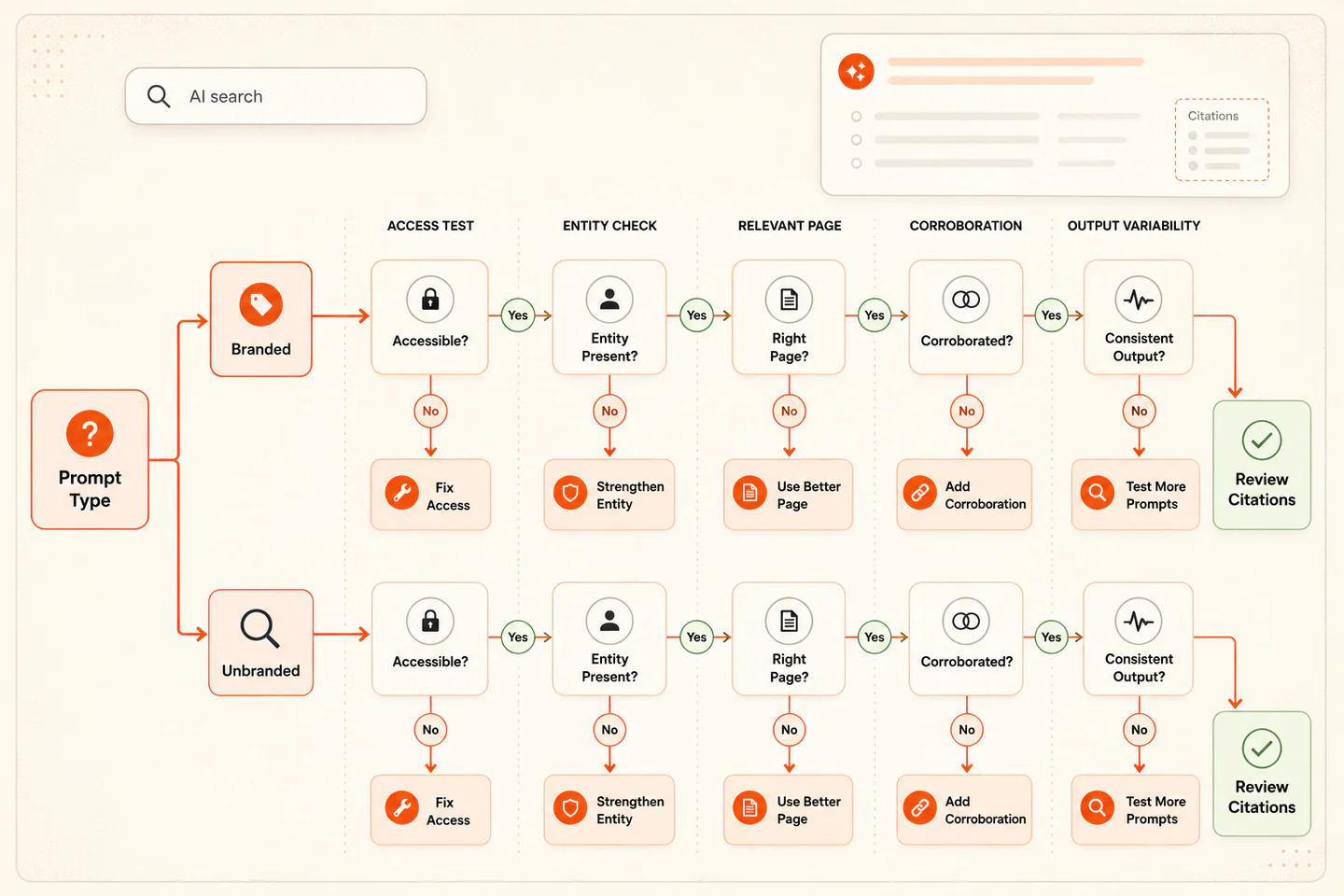
Prompt wording, location, account context, product mode, date and source selection can change the result. OpenAI states that top placement cannot be guaranteed. Strong evidence improves the opportunity, not control.
Test branded and unbranded visibility separately
Branded prompts ask whether the system can identify and describe the known entity:
- “What services does [business] provide?”
- “Where does [business] operate?”
- “Is [business] suitable for [specific need]?”
Unbranded prompts test discovery among alternatives:
- “Which Irish providers offer [service]?”
- “How should an Irish SME choose help with [problem]?”
- “Compare options for [service] in Cork.”
Passing branded tests but failing unbranded ones suggests a relevance/corroboration gap rather than basic identity failure. Failing branded factual tests deserves priority.
Build a lightweight benchmark
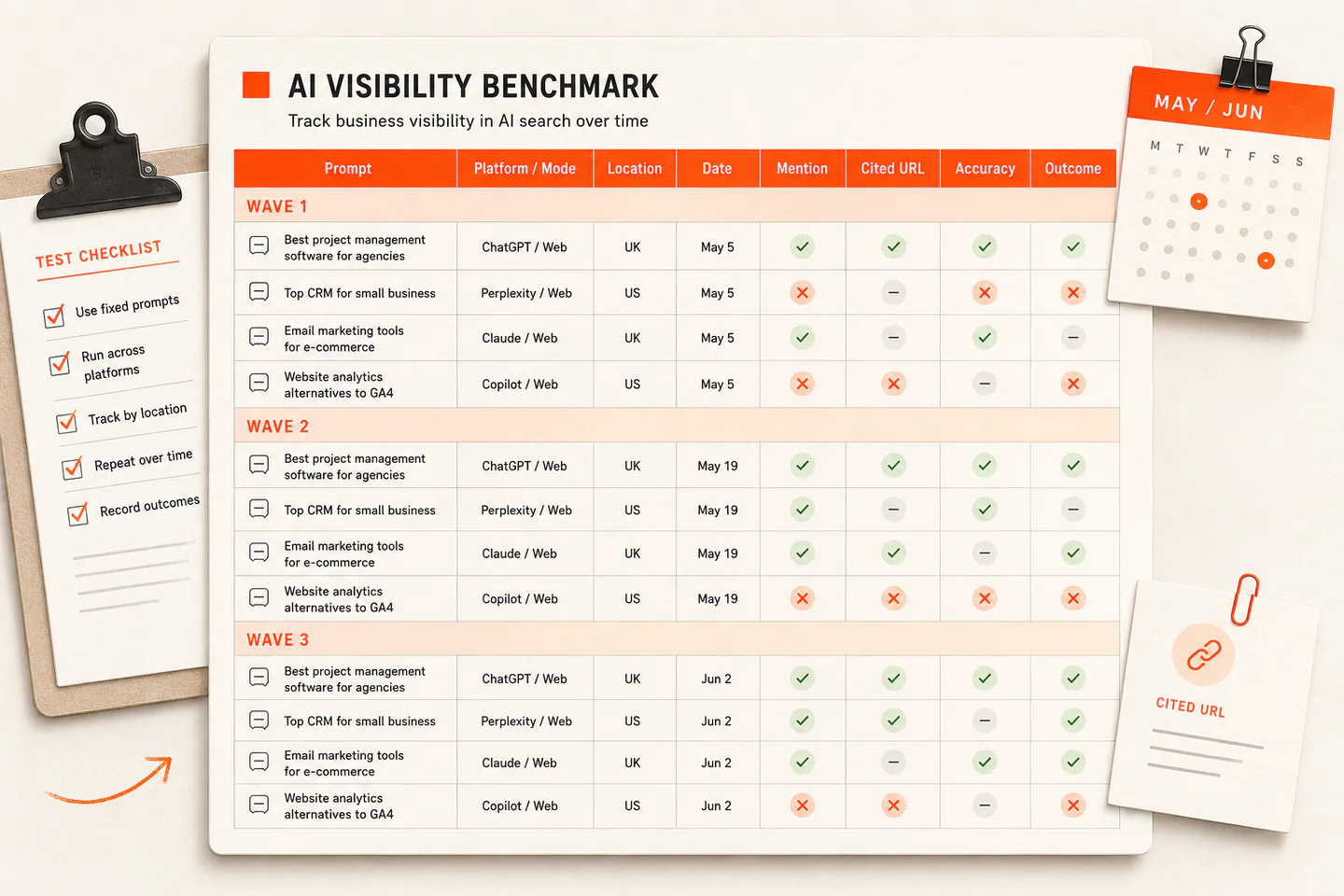
Choose 15–30 realistic prompts across category discovery, problem-solving, comparison, local intent and brand verification. For every row record:
| Field | Why it matters |
|---|---|
| Exact prompt and ID | Makes waves reproducible |
| Platform and mode | Search-enabled and non-search experiences differ |
| Date/time | Products and sources change |
| Account/location state | Personalisation/local context may affect answers |
| Brand mention/context | Separates useful from incidental mentions |
| Cited URL/domain | Shows which source supported the answer |
| Material accuracy | Visibility with wrong facts can be harmful |
| Destination/action | Tests whether the result can convert |
Run each prompt once per wave. Do not regenerate only the answers you dislike. Preserve raw outputs or screenshots and report counts beside percentages.
Interpret the patterns
- Wrong branded facts: correct the entity ledger and authoritative sources.
- Brand known, never category-relevant: strengthen the definitive service page and independent evidence.
- Third-party sources cited, owned site ignored: improve owned source-worthiness, crawlability and internal links.
- Owned page cited but no enquiries: improve the landing-page proof, qualification and action.
- Results fluctuate substantially: maintain the sample, expand cautiously and avoid reactive rewrites.
These are diagnostic hypotheses, not disclosed platform ranking factors.
Connect the test to business results
OpenAI’s publisher FAQ says ChatGPT referral URLs use utm_source=chatgpt.com. Segment known referrals, landing pages, engagement, form starts and qualified outcomes.
Add a neutral enquiry question such as “How did you first hear about us?” because copied links, calls, later branded searches and cross-device visits may not preserve referral data. Keep direct referrals, self-reported discovery and merely possible influence separate.
What to improve first
- Fix blocked access and erroneous public facts.
- Strengthen the highest-value service page.
- Add approved evidence and primary sources.
- Correct important third-party records.
- Improve cited landing-page conversion.
- Repeat the exact benchmark after a meaningful review interval.
Do not buy mentions, fake reviews or undisclosed “independent” lists. Do not create hundreds of thin Q&As to chase every prompt.
What to do next
Save a baseline before making changes. Start with five branded and ten unbranded prompts, then trace each failure to access, retrieval, identity, relevance, evidence or variable selection.
The complete ChatGPT visibility guide provides the deeper 30/60/90-day process, while the AI SEO Ireland guide covers platform controls and content strategy. Hatch’s AI Search Optimisation service can run a documented AI visibility benchmark rather than sell a guaranteed mention.
Common questions
Frequently Asked Questions
Why does ChatGPT mention competitors but not my business?
Possible causes include blocked search-crawler access, weak relevance to the exact question, ambiguous business facts, thin owned content, limited independent corroboration, stronger competing sources or normal answer variability. Test each layer rather than assuming one cause.
Can I submit my business to ChatGPT?
There is no universal submission that guarantees a business mention. OpenAI says public sites can appear in ChatGPT Search and advises allowing OAI-SearchBot and its published IPs, but ranking uses multiple factors and placement is not guaranteed.
How do I test whether ChatGPT can find my business?
Use both branded and unbranded fixed prompts, record platform/mode, wording, date, location/account state, mention, citation URL and factual accuracy, and repeat the same set in scheduled waves.
Does one missing answer mean my website is blocked?
No. Absence can result from relevance, source selection or normal variability even when pages are accessible. Check robots, firewall and server logs independently instead of inferring crawl status from one response.
How often should I run an AI visibility benchmark?
Run a baseline, then repeat monthly or after material technical, content or corroboration changes. Daily testing usually adds noise and encourages reactive edits.
Can ChatGPT referral traffic be measured?
OpenAI says ChatGPT referral URLs include utm_source=chatgpt.com, which supports analytics. It will not capture every influenced journey, such as later branded searches, copied links, calls or cross-device visits.
Want Us To Look At Your Version?
Show us what is not working and we’ll give you a straight answer.
Founder of Hatch. Writing practical, jargon-free advice for businesses that want to get found and turn attention into enquiries.